Discovery of Gold in California, by Gen. John Sutter
An Eyewitness to the Gold Discovery
A Rush to the Gold Washings – From the California Star
Military Governor Mason’s Report on the Discovery of Gold
William T. Sherman and the Gold Rush
Dramatic Impact of the Gold Discovery, by Theo. H. Hittell
The Discovery – as Viewed in New York and London
Gold Rush and Anti-Chinese Race Hatred
Other Museum Gold Rush Items
William T. Sherman and Early Calif. History
Biography of William T. Sherman
California Gold Rush Chronology 1846 - 1849
California Gold Rush Chronology 1850 - 1851
California Gold Rush Chronology 1852 - 1854
California Gold Rush Chronology 1855 - 1856
California Gold Rush Chronology 1857 - 1861
California Gold Rush Chronology 1862 - 1865
Steamer Day in the 1850s
Sam Brannan Opens New Bank - 1857
|
Sherman and the Discovery of Gold
In Chapter II of his memoirs, Gen. Sherman writes
of his tour of the gold fields, meeting with Gen. Sutter, the Mormons at Morman
Island, Kit Carson, and how news of the gold discovery reached Washington, D.C.
– and the world.
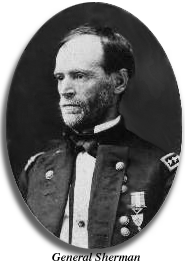 I remember one day, in the spring of 1848, that two men, Americans, came
into the office and inquired for the Governor. I asked their business, and one answered
that they had just come down from Captain Sutter on special business, and they wanted
to see Governor Mason in person. I took them in to the colonel, and left
them together. After some time the colonel came to his door and called to me. I
went in, and my attention was directed to a series of papers unfolded on his table,
in which lay about half an ounce of placer-gold. Mason said to me, “What
is that?” I touched it and examined one or two of the larger pieces, and asked,
“Is it gold?” Mason asked me if I had ever seen native gold. I answered
that, in 1844, I was in Upper Georgia, and there saw some native gold, but it was
much finer than this, and it was in phials, or in transparent quills; but I said
that, if this were gold, it could be easily tested, first, by its malleability,
and next by acids. I took a piece in my teeth, and the metallic lustre was perfect.
I then called to the clerk, Baden, to bring an axe and hatchet from the backyard.
When these were brought I took the largest piece and beat it out flat, and beyond
doubt it was metal, and a pure metal. Still, we attached little importance to the
fact, for gold was known to exist at San Fernando, at the south, and yet was not
considered of much value.
I remember one day, in the spring of 1848, that two men, Americans, came
into the office and inquired for the Governor. I asked their business, and one answered
that they had just come down from Captain Sutter on special business, and they wanted
to see Governor Mason in person. I took them in to the colonel, and left
them together. After some time the colonel came to his door and called to me. I
went in, and my attention was directed to a series of papers unfolded on his table,
in which lay about half an ounce of placer-gold. Mason said to me, “What
is that?” I touched it and examined one or two of the larger pieces, and asked,
“Is it gold?” Mason asked me if I had ever seen native gold. I answered
that, in 1844, I was in Upper Georgia, and there saw some native gold, but it was
much finer than this, and it was in phials, or in transparent quills; but I said
that, if this were gold, it could be easily tested, first, by its malleability,
and next by acids. I took a piece in my teeth, and the metallic lustre was perfect.
I then called to the clerk, Baden, to bring an axe and hatchet from the backyard.
When these were brought I took the largest piece and beat it out flat, and beyond
doubt it was metal, and a pure metal. Still, we attached little importance to the
fact, for gold was known to exist at San Fernando, at the south, and yet was not
considered of much value.
Colonel Mason then handed me a letter from Captain Sutter,
addressed to him, stating that he (Sutter) was engaged in erecting a saw-mill at Coloma, about forty miles up the
American Fork, above his fort at New Helvetia, for the general benefit of the settlers in that
vicinity; that he had incurred considerable expense, and wanted a “preëmption” to the
quarter-section of land on which the mill was located, embracing the tail-race in which this particular gold had been found. Mason
instructed me to prepare a letter, in answer, for his signature. I wrote off a letter,
reciting that California was yet a Mexican province, simply held by us as a conquest;
that no laws of the United States yet applied to it, much less the land laws or
preëmption laws, which could only apply after a public survey. Therefore it
was impossible for the Governor to promise him (Sutter) a title to the land; yet,
as there were no settlements within forty miles, he was not likely to be disturbed
by trespassers. Colonel Mason signed the letter, handed it to one of the gentlemen
who had brought the sample of gold, and they departed.
That gold was the first discovered in the Sierra
Nevada, which soon revolutionized the whole country, and actually moved the whole
civilized world.
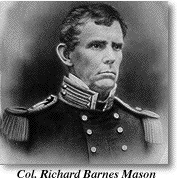 Sherman described Richard Barnes Mason, the newly-arrived, and fifth
military governor of California (1847-1849), with whom then-Lieutenant Sherman
would work closely: “Colonel R. B. Mason, First Dragoons, was an
officer of great experience, of stern character, deemed by some harsh and severe,
but in my intercourse with him he was kind and agreeable. He had a large fund of
good sense, and, during our long period of service together, I enjoyed his unlimited
confidence.”
Sherman described Richard Barnes Mason, the newly-arrived, and fifth
military governor of California (1847-1849), with whom then-Lieutenant Sherman
would work closely: “Colonel R. B. Mason, First Dragoons, was an
officer of great experience, of stern character, deemed by some harsh and severe,
but in my intercourse with him he was kind and agreeable. He had a large fund of
good sense, and, during our long period of service together, I enjoyed his unlimited
confidence.”
San Francisco’s Fort Mason and Mason St. are
named for him. Col. Mason, and Lt. Sherman, had offices at Monterey, the capital
of Alta California. Sherman then described his adventures near San José and
the quicksilver mines of New Almaden. Then, he wrote:
As the spring and summer of 1848 advanced, the reports came faster and faster from
the gold-mines at Sutter’s saw-mill. Stories reached us of fabulous discoveries,
and spread throughout the land. Everybody was talking of “Gold! gold!!” until it assumed
the character of a fever. Some of our soldiers began to desert; citizens were fitting out trains
of wagons and pack-mules to go to the mines. We heard of men earning fifty, five
hundred, and thousands of dollars per day, and for a time it seemed as though somebody
would reach solid gold. Some of this gold began to come to Yerba Buena [San Francisco]
in trade, to disturb the value of merchandise, particularly of mules, horses, tin pans, and
articles used in mining. I of course could not escape the infection, and at last convinced
Colonel Mason that it was our duty to go up and see with our own eyes, that we might
report the truth to our Government. As yet we had no regular mail to any part of the United
States, but mails had come to us at long intervals, around Cape Horn, and one or two
overland. I well remember the first overland mail. It was brought by Kit Carson in
saddle-bags from Taos in New Mexico. We heard of his arrival at Los Angeles, and waited
patiently for his arrival at headquarters. His fame then was at its height, from the
publication of Frémont’s books, and I was very anxious to see a man who had
achieved such feats of daring among the wild animals of the Rocky Mountains, and with
wilder Indians of the Plains.
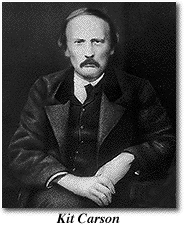 At last his arrival was reported at the tavern at Monterey, and I
hurried to hunt him up. I cannot express my surprise at beholding a small,
stoop-shouldered man, with reddish hair, freckled face, soft blue eyes, and nothing to
indicate extraordinary courage or daring. He spoke but little, and answered questions in
monosyllables. I asked for his mail, and he picked up his light saddle-bags
containing the great overland mail, and we walked together
to headquarters, where he delivered his parcel into Colonel Mason’s own hands....
At last his arrival was reported at the tavern at Monterey, and I
hurried to hunt him up. I cannot express my surprise at beholding a small,
stoop-shouldered man, with reddish hair, freckled face, soft blue eyes, and nothing to
indicate extraordinary courage or daring. He spoke but little, and answered questions in
monosyllables. I asked for his mail, and he picked up his light saddle-bags
containing the great overland mail, and we walked together
to headquarters, where he delivered his parcel into Colonel Mason’s own hands....
Toward the close of June, 1848, the gold-fever being at its height, by Colonel
Mason’s orders, I made preparations for his trip to the newly-discovered
gold-mines at Sutter’s Fort. I selected four good soldiers, with Aaron, Colonel Mason’s
black servant, and a good outfit of horses and pack-mules, we started by the usually
traveled route for Yerba Buena. There Captain Folsom and two citizens joined our party.
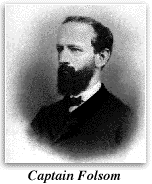
Sherman related how the party crossed the bay, and first went to San Rafael, then to visit Gen. Vallejo at
Sonoma before moving onward to New Helvetia. Col. Mason, with Lt. Sherman and
John L. Folsom, finally arrived at Sutter’s Fort.
At that time there was not the sign of a habitation there or thereabouts, except the fort, and
an old adobe-house, east of the fort, known as the hospital. The fort itself was one
of adobe-walls, about twenty feet high, rectangular in form, with two-story
block-houses at diagonal corners. The entrance was by a large gate, open by day
and closed at night, with two iron ship’s guns near at hand. Inside there was a large house,
with a good shingle-roof, used as a storehouse, and all round the walls were ranged
rooms, the fort-wall being the outer wall of the house. The inner wall also was of
adobe. These rooms were used by Captain Sutter and by his people. He had a blacksmith’s
shop, carpenter’s shop, etc., and other rooms where the women made blankets. Sutter was
monarch of all he surveyed, and authority to inflict punishment even unto death, a power
he did not fail to use. He had horses, cattle, and sheep, and of these he gave liberally and
without price to all in need. He caused to be driven into our camp a beef and some sheep,
which were slaughtered for our use. Already the gold-mines were beginning to be
felt. Many people were then encamped, some going and some coming, all full of
gold-stories, and each surpassing the other. We found preparations in progress for
celebrating the Fourth of July, then close at hand, and we agreed to remain over to assist on
the occasion; of course, being the high officials, we were the honored guests. People came
from a great distance to attend this celebration of the Fourth of July, and the tables were
laid in a large room inside the storehouse of the fort. A man of some note, named Sinclair,
presided, and after a substantial meal and a reasonable supply of aguardiente [brandy] we
then began the toasts. All that I remember is that Folsom and I spoke for our party; others,
Captain Sutter included, made speeches, and before the celebration was over Sutter was
enthusiastic, and many others showed the effects of the aguardiente. The next day
(namely July 5, 1848) we resumed our journey toward the mines, and, in
twenty-five miles of as hot and dusty a ride as possible, we reached Mormon Island. I have
heretofore stated that the gold was first found in the tail-race of the saw-mill at
Coloma, forty miles above Sutter’s Fort, or fifteen above Mormon Island, in the bed of the
American Fork of the Sacramento River. It seemed that Sutter had employed an American
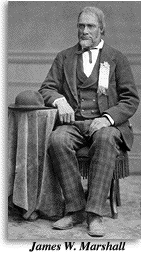
named Marshall, a sort of millwright, to do his work for him, but Marshall afterward
claimed that in the matter of the saw-mill they were co-partners. At all events,
Marshall and the family of Mr. Wimmer were living at Coloma, where the pine-trees
afforded the best material for lumber. He had under him four white men, Mormons, who
had been discharged from Cooke’s Battalion, and some Indians. These were engaged in
hewing logs, building a mill-dam, and putting up a saw-mill. Marshall, as
architect, had made the “tub-wheel,” and had set it in motion, and had also furnished
some of the rude parts of machinery necessary for an ordinary
up-and-down
saw-mill.
 Labor
was very scarce, expensive, and had to be economized. The mill was built over a
dry channel of the river which was calculated to be the tail-race. After arranging his
head-race, dam and tub-wheel, he let on the water to test the
goodness of his machinery. It worked very well until it was found that the tail-race
did not carry off the water fast enough, so he put his men to work in a rude way to clear
out the tail-race. They scratched a kind of ditch down the middle of the dry channel,
throwing the coarser stones to one side; then, letting on the water again, it would run with
velocity down the channel, washing away the dirt, thus saving labor. This course of action
was repeated several times, acting exactly like the long Tom afterward resorted to by the
miners. As Marshall himself was working in this ditch, he observed particles of yellow
metal which he gathered up in his hand, when it seemed to have suddenly flashed across
his mind that it was gold. After picking up about an ounce, he hurried down to the
fort to report to Captain Sutter his discovery. Captain Sutter himself related to me
Marshall’s account, saying that, as he sat in his room at the fort one day in February or
March, 1848, a knock was heard at his door, and he called out, “Come in.” In walked
Marshall, who was a half-crazy man at best, but then looked strangely wild. “What
is the matter, Marshall?” Marshall inquired if any one was within hearing, and began to
peer about the room, and look under the bed, when Sutter, fearing that some calamity had
befallen the party up at the saw-mill, and that Marshall was really crazy, began to
make his way to the door, demanding of Marshall to explain what was the matter. At last he
revealed his discovery and laid before Captain Sutter the pellicles of gold he had picked up
in the ditch. At first, Sutter attached little or no importance to the discovery, and told
Marshall to go back to the mill, and say nothing of what he had seen to Mr. Wimmer, or
any one else. Yet, as it might add value to the location, he dispatched to our headquarters at
Monterey, as I have already related, the two men with a written application for a
preëmption to the quarter-section of land at Coloma. Marshall returned to the
mill, but could not keep out of his wonderful ditch, and by some means the other men
employed there learned his secret. They then wanted to gather the gold, and Marshall
threatened to shoot them if they attempted it; but these men had sense enough to know that
if “placer”-gold existed at Coloma, it would also be found farther
down-stream, and they gradually “prospected” until they reached Mormon Island, fifteen
miles below, where they discovered one of the richest placers on earth. These men revealed
the fact to some other Mormons who were employed by Captain Sutter at a grist-mill he was building still lower down the American Fork,
and six miles above his fort. All of them struck for high wages, to which Sutter
yielded, until they asked ten dollars a day, which he refused, and the two mills
on which he had spent so much money were never built, and fell into decay. Labor
was very scarce, expensive, and had to be economized. The mill was built over a
dry channel of the river which was calculated to be the tail-race. After arranging his
head-race, dam and tub-wheel, he let on the water to test the
goodness of his machinery. It worked very well until it was found that the tail-race
did not carry off the water fast enough, so he put his men to work in a rude way to clear
out the tail-race. They scratched a kind of ditch down the middle of the dry channel,
throwing the coarser stones to one side; then, letting on the water again, it would run with
velocity down the channel, washing away the dirt, thus saving labor. This course of action
was repeated several times, acting exactly like the long Tom afterward resorted to by the
miners. As Marshall himself was working in this ditch, he observed particles of yellow
metal which he gathered up in his hand, when it seemed to have suddenly flashed across
his mind that it was gold. After picking up about an ounce, he hurried down to the
fort to report to Captain Sutter his discovery. Captain Sutter himself related to me
Marshall’s account, saying that, as he sat in his room at the fort one day in February or
March, 1848, a knock was heard at his door, and he called out, “Come in.” In walked
Marshall, who was a half-crazy man at best, but then looked strangely wild. “What
is the matter, Marshall?” Marshall inquired if any one was within hearing, and began to
peer about the room, and look under the bed, when Sutter, fearing that some calamity had
befallen the party up at the saw-mill, and that Marshall was really crazy, began to
make his way to the door, demanding of Marshall to explain what was the matter. At last he
revealed his discovery and laid before Captain Sutter the pellicles of gold he had picked up
in the ditch. At first, Sutter attached little or no importance to the discovery, and told
Marshall to go back to the mill, and say nothing of what he had seen to Mr. Wimmer, or
any one else. Yet, as it might add value to the location, he dispatched to our headquarters at
Monterey, as I have already related, the two men with a written application for a
preëmption to the quarter-section of land at Coloma. Marshall returned to the
mill, but could not keep out of his wonderful ditch, and by some means the other men
employed there learned his secret. They then wanted to gather the gold, and Marshall
threatened to shoot them if they attempted it; but these men had sense enough to know that
if “placer”-gold existed at Coloma, it would also be found farther
down-stream, and they gradually “prospected” until they reached Mormon Island, fifteen
miles below, where they discovered one of the richest placers on earth. These men revealed
the fact to some other Mormons who were employed by Captain Sutter at a grist-mill he was building still lower down the American Fork,
and six miles above his fort. All of them struck for high wages, to which Sutter
yielded, until they asked ten dollars a day, which he refused, and the two mills
on which he had spent so much money were never built, and fell into decay.
Go to Part II of Sherman and the Gold Rush
Return to the top of the page.
|