Discovery of Gold in California, by Gen. John Sutter
An Eyewitness to the Gold Discovery
A Rush to the Gold Washings – From the California Star
Military Governor Mason’s Report on the Discovery of Gold
William T. Sherman and the Gold Rush
Dramatic Impact of the Gold Discovery, by Theo. H. Hittell
The Discovery – as Viewed in New York and London
Gold Rush and Anti-Chinese Race Hatred
Other Museum Gold Rush Items
William T. Sherman and Early Calif. History
Biography of William T. Sherman
California Gold Rush Chronology 1846 - 1849
California Gold Rush Chronology 1850 - 1851
California Gold Rush Chronology 1852 - 1854
California Gold Rush Chronology 1855 - 1856
California Gold Rush Chronology 1857 - 1861
California Gold Rush Chronology 1862 - 1865
Steamer Day in the 1850s
Sam Brannan Opens New Bank - 1857
|
Sherman and the Discovery of Gold - Part II
In Part II, Gen. Sherman continues his tour of the gold fields, tells of
his meeting the Mormons at Mormon Island, and how news of the gold discovery reached
Washington, D.C. – and the world.
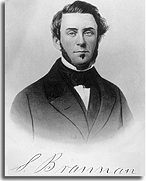 In my opinion, when the Mormons were driven from Nauvoo,
Illinois, in 1844, they cast about for a land where they would not be disturbed
again, and fixed on California. In the year 1845 a ship,
the Brooklyn, sailed from New York for California, with a colony of Mormons,
of which Sam Brannan was the leader, and we found them there on our arrival in January,
1847.
In my opinion, when the Mormons were driven from Nauvoo,
Illinois, in 1844, they cast about for a land where they would not be disturbed
again, and fixed on California. In the year 1845 a ship,
the Brooklyn, sailed from New York for California, with a colony of Mormons,
of which Sam Brannan was the leader, and we found them there on our arrival in January,
1847.
When General Kearny, at Fort Leavenworth, was collecting volunteers early
1846, for the Mexican War, he, through the instrumentality of Captain James Allen,
brother to our quartermaster, General Robert Allen, raised the battalion of Mormons
at Kanesville, Iowa, now Council Bluffs, on the express understanding that it would
facilitate their migration to California. But when the Mormons reached Salt Lake,
in 1846, they learned that they had been forestalled by the United States forces
in California, and they then determined to settle down where they were. Therefore,
when this battalion of five companies of Mormons (raised by Allen, who died on the
way, and was succeeded by Cooke) was discharged at Los Angeles, California, in the
early summer of 1847, most of the men went to their people at Salt Lake, with all
the money received, as pay from the United States, invested in cattle and breeding-horses; one company reënlisted
for another year, and the remainder sought work in the country.
As soon as the fame of the
gold discovery spread through California, the Mormons naturally turned to Mormon
Island, so that in July, 1848, we found about three hundred of them there at work. Sam
Brannan was on hand as the high-priest, collecting the tithes. Clark, of Clark’s
Point, an early pioneer, was there also, and nearly all the Mormons who had come out in
the Brooklyn, or who had staid in California after the discharge of their battalion, had
collected there. I recall the scene as perfectly to-day as though it were yesterday. In
the midst of a broken country, all parched and dried by the hot sun of July, sparsely
wooded with live-oaks and straggling pines, lay the valley of the American River,
with its bold mountain-stream coming out of the Snowy Mountains to the east.
In this valley is a flat, or gravel-bed, which in high water is an island, or is overflow,
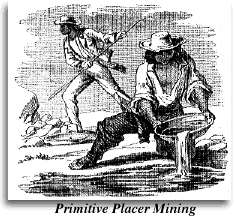
but at the time of our visit was simply a level gravel-bed of the river. On its edges
men were digging, and filling buckets with the finer earth and gravel, which was carried to
a machine made like a baby’s cradle, open at the foot, and at the head a plate of
sheet-iron or zinc, punctured full of holes. On this metallic plate was emptied the
earth, and water was then poured on it from buckets, while one man shook the cradle with violent
rocking by a handle. On the bottom were nailed cleats of wood. With this rude machine
four men could earn from forty to one hundred dollars a day, averaging sixteen dollars, or a
gold ounce, per man per day.
While the sun blazed down on the heads of the miners with
tropical hats, the water was bitter cold, and all hands were either standing in the water or
had their clothes wet all the time; yet there were no complaints of rheumatism or cold. We
made our camp on a small knoll, a little below the island, and from it could overlook the
busy scene. A few brush-res, boarding-houses,
and for sleeping; but all hands slept on the ground, with pine-leaves and blankets for
bedding. As soon as the news spread that the Governor was there, persons came to see us,
and volunteered all kinds of information, illustrating it by samples of gold, which was of a
uniform kind, “scale gold.” I remember that Mr. Clark was in camp, talking to Colonel
Mason about matters and things generally, when he inquired, “Governor, what business
has Sam Brannan to collect the tithes here?” Clark admitted that Brannan was head of the
Mormon church in California, and he as simply questioning as to Brannan’s right, as
high-priest, to compel the Mormons to pay him the regular tithes.
Colonel Mason
answered, “Brannan has a perfect right to collect the tax, if you Mormons are fools enough to pay it.” “Then,”
said Clark, “I for one won’t pay it any longer.” Colonel Mason added:
“This is public land, and the gold is the property of the United States; all
of you here are trespassers, but, as the Government is benefited by your getting
out the gold, I do not intend to interfere.” I understood, afterward, that
from that time the payment of the tithes ceased, but Brannan had already collected
enough money wherewith to hire Sutter’s hospital, and to open a store there,
in which he made more money than any merchant in California, during that summer
and fall. The understanding was, that the money collected by him as tithes was the
foundation of his fortune, which is still very large in San Francisco. That evening
we all mingled freely with the miners, and witnessed the process of cleaning up
and “panning” out, which is the last process of separating the pure gold
from the fine dirt and black sand.
The next day we continued our journey up the valley
of the American Fork, stopping at various camps, where mining was in progress; and
about noon we reached Coloma, the place where gold had been first discovered. The
hills were higher, and the timber of better quality. The river was narrower and
bolder, and but few miners were at work there, by reason of Marshall’s and
Sutter’s claim to the site. There stood the saw-mill
unfinished, the dam and tail-race just as they were left when the Mormons ceased
work. Marshall and Wimmer’s family of wife and half a dozen children were there,
guarding their supposed treasure; living in a house made of clapboards. Here also we were
shown the many specimens of gold, of a coarser grain that that found at Mormon Island.
The next day we crossed the American River to its north side, and visited many small
 camps of men, in
what we called the “dry diggings.” Little
pools of water stood in the beds of the streams, and these were used to wash the
dirt; and there the gold was in every conceivable shape and size, some of the specimens
weighing several ounces. Some of these “diggings” were extremely rich,
but as a whole they were more precarious in results than the river. Sometimes a
lucky fellow would hit on a “pocket,” and collect several thousand dollars
in a few days, and then again he would be shifting about from place to place, “prospecting,”
and spending all he had made. Little stores were being opened at every point, where
flour, bacon, etc., were sold; every thing being a dollar a pound, and a meal usually
costing three dollars. Nobody paid for a bed, for he slept on the ground, without
fear of cold or rain. We spent nearly a week in that region, and were quite bewildered
by the fabulous tales of recent discoveries, which at the time were confined to
the several forks of the American and Yuba Rivers. camps of men, in
what we called the “dry diggings.” Little
pools of water stood in the beds of the streams, and these were used to wash the
dirt; and there the gold was in every conceivable shape and size, some of the specimens
weighing several ounces. Some of these “diggings” were extremely rich,
but as a whole they were more precarious in results than the river. Sometimes a
lucky fellow would hit on a “pocket,” and collect several thousand dollars
in a few days, and then again he would be shifting about from place to place, “prospecting,”
and spending all he had made. Little stores were being opened at every point, where
flour, bacon, etc., were sold; every thing being a dollar a pound, and a meal usually
costing three dollars. Nobody paid for a bed, for he slept on the ground, without
fear of cold or rain. We spent nearly a week in that region, and were quite bewildered
by the fabulous tales of recent discoveries, which at the time were confined to
the several forks of the American and Yuba Rivers.
Here, along the American River, Col. Mason’s
party was met by a courier from Monterey, and told of the arrival of a ship there,
with important dispatches from Mazatlan.
On reaching Monterey, we found dispatches from Commodore
Shubrick at Mazatlan, which gave almost positive assurance that the war with Mexico
was over; that hostilities had ceased, and commissioners were arranging the terms
of peace at Guadalupe Hidalgo. It was well that this news reached California at
that critical time; for so contagious had become the “gold-fever” that
everybody was bound to go and try his fortune, and
the volunteer regiments of Stevenson’s would have deserted en masse, had the men
not been assured that they would very soon be entitled to an honorable discharge.
Many of our regulars did desert, among them the very men who had escorted us faithfully
to the mines and back. Our servants also left us, and nothing less than three hundred
dollars a month would hire a man in California; Colonel Mason’s black boy, Aaron, alone
of all our then servants proving faithful. We were forced to resort to all manner of shifts to
live. First, we had a mess with a black fellow we called Bustamente as cook; but he got the
fever and had to go. We next took a soldier, but he deserted, and carried off my
double-barreled shot-gun, which I prized very highly. To meet this conditions of
facts, Colonel Mason ordered that liberal furloughs
should be given to soldiers, and promises to all in turn, and he allowed all the
officers to draw their rations in kind. As the actual value of the ration was very
large, this enabled us to live. Halleck, Murray, Ord, and I, boarded with Doña
Augustias, and in turn our rations as pay for our board.
Some time in September, 1848, the official news of the
treaty of peace reached us, and the Mexican War was
over. This treaty was signed in May, and came to us all the way by land
by a courier from Lower California, sent from La Paz by Lieutenant-Colonel
Burton. On its receipt, orders were at once made for the muster-out of all of
Stevenson’s regiment, and our military forces were thus
reduced to a single company of dragoons at Los Angeles, and the one company of artillery
at Monterey. Nearly all business had ceased, except that connected with gold; and,
during that fall, Colonel Mason, Captain Warner, and I, made another trip up to
Sutter’s Fort, going to the newly discovered mines on the Stanislaus, called
“Sonora,” named from miners of Sonora, Mexico, who had first discovered
them. We found there pretty much the same state of facts as before existed at Mormon
Island and Coloma, and we daily received intelligence of the opening of still other
mines north and south.
But I have passed over a very interesting fact. As soon
as we returned from our first visit to the gold-mines, it became important to send home positive knowledge of this
valuable discovery. The means of communication with the United States were very
precarious, and I suggested to Colonel Mason that a special courier ought to be sent; that
Second-Lieutenant [Lucian] Loeser had been promoted to first-lieutenant, and
was entitled to go home. He was accordingly detailed to carry the news. I prepared with great
care the letter to the adjutant-general of August 17, 1848, which Colonel Mason
modified in a few particulars; and, as it was important to send not only the specimens
which had been presented to us along our route of travel, I advised the colonel to allow
Captain Folsom to purchase and send to Washington a large sample of the commercial gold
in general use, and to pay for the same out of the money in his hands known as the “civil
fund,” arising from duties collected at the several ports in California. He consented to this,
and Captain Folsom bought an oyster-can full at ten dollars the ounce, which was
the rate of value at which it was then received at the custom-house. Folsom was
instructed further to contract with some vessel to carry the messenger to South America,
where he would take the English steamers as far east as Jamaica, with a conditional charter
giving increased payment if the vessel could catch the October steamer. Folsom chartered
the bark La Lambayecana, owned and navigated by Henry D. Cooke, who has since been
the Governor of the District of Columbia. In due time this vessel reached Monterey, and
Lieutenant Loeser, with his report and specimens of gold, embarked and sailed. He reached
the South American Continent at Payta, Peru, in time, took the English steamer of October
to Panama, and thence went on to Kingston, Jamaica, where he found a
sailing-vessel bound for New Orleans. On reaching New Orleans, he telegraphed the War
Department his arrival; but so many delays had occurred
that he did not reach Washington in time to have the matter embraced in the President’s
regular message of 1848, as we had calculated. Still, the President made it the
subject of a special message, and thus became “official” what had before
only reached the world in a very indefinite shape. Then began that wonderful development,
and the great emigration to California, by land and by sea, of 1849 and 1850.
As before narrated, Mason, Warner, and I, made a second
visit to the mines in September and October, 1848. As the winter season approached,
Colonel Mason returned to Monterey, and I remained for a time at Sutter’s Fort.
In order to share somewhat in the riches of the land, we formed a partnership in
a store at Coloma, in charge of Norman S. Bestor, who had been Warner’s clerk.
We supplied the necessary money, fifteen hundred dollars (five hundred dollars each),
and Bestor carried on the store at Coloma for his share. Out of this investment,
each of us realized a profit of about fifteen hundred dollars. Warner also got a
regular leave of absence, and contract with Captain Sutter for survey and locating
the town of Sacramento. He received for this sixteen dollars per day for his services
as a surveyor; and Sutter paid all the hands engaged in the work. The town was laid
off mostly up about the fort, but a few streets were staked off along the river-bank, and one or
two leading to it. Captain Sutter always contended, however, that no town could possibly
exist on the immediate bank of the river, because the spring freshets rose over the bank,
and frequently it was necessary to swim a horse to reach the boat-landing.
nevertheless, from the very beginning the town began to be built on the very
river-bank, viz., First, Second, and Third Streets, with J and K Streets leading back.
Among the principal merchants and traders of that
winter, at Sacramento, were Sam Brannan and Hensley, Reading & Co. For several years
the site was annually flooded; but the people have persevered in building the levees,
and afterward in raising all the streets, so that Sacramento is now a fine city,
the capital of the State, and stand were, in 1848, nothing but a dense mass of bushes,
vines, and submerged land. The old fort has disappeared altogether.
During the fall of 1848, Warner, Ord, and I, camped
on the bank of the American River, abreast of the fort, at what was known as the
“Old Tan-Yard.” I was cook, Ord cleaned up the dishes, and Warner
looked after the horses; but Ord was deposed as scullion because he would only wipe
the tin plates with a tuft of grass, according to the custom of the country, whereas
Warner insisted on having them washed after each meal with hot water. Warner was
in consequence promoted to scullion, and Ord became the hostler. We drew our rations
in kind from the commissary at San Francisco, who sent them up to us by a boat;
and we were thus enabled to dispense a generous hospitality to many a poor devil
who otherwise would have had nothing to eat.
The winter of 1848–1849 was a period of intense
activity throughout California. The rainy season was unfavorable to the operations
of gold-mining, and was very hard upon the thousands of houseless men and women
who dwelt in the mountains, and even in the towns. Most of the natives and old inhabitants
had returned to their ranches and houses; yet there were not roofs enough in the
country to shelter the thousands who had arrived by sea and by land. The news had
gone forth to the whole civilized world that gold in fabulous quantities was to
be had for the mere digging, and adventurers came pouring in blindly to seek their
fortunes, without a thought of house or food. Yerba Buena had been converted into
San Francisco. Sacramento City had been laid out, lots were being rapidly sold,
and the town was being built up as an entrepot to the mines. Stockton also had been
chosen as a convenient point for trading with the lower or southern mines. Captain
Sutter was sole proprietor of the former, and Captain Charles Weber was the owner
of the site of Stockton, which was as yet known as “French Camp.”
From:Memoirs of W.T. Sherman
Chapter II: Early Recollections of California
Return to the top of the page.
|