The Whitcomb Hotel Studios
KFRC and the Don Lee Networks
Edna Fischer - "First Lady of Radio"
Anson Weeks and His Orchestra
Early KFRC Advertisement
KFRC Announcers – 1931
Tommy Harris at the KFRC Microphone
Meredith Willson at KFRC
Meredith Willson Biography
History of Don Lee Television
Chronology of the Summer of Love
Reel Top 40 Radio Home Page
History of Bay Area Broadcasting
|
KFRC - San Francisco
KFRC went on the air in 1924, with its first studios in the Whitcomb Hotel
on Market Street, and, in 1925, moved to the City of Paris department store building,
at Stockton and Geary streets. Southern California automobile dealer Don Lee purchased
the station in 1926, and the studios moved to the new Don Lee Cadillac Building
at 1000 Van Ness Avenue. The callsign “KFRC” stands for “Known For
Radio Clearness,” to promote its then-new efficient Western Electric transmitter
system.
Among the early artists on the station was Edna Fischer, pianist on the
famous “Blue Monday Jamboree” during the late 1920s.
KFRCs first “golden era” began in the late 1920s with the Jamboree,
and the sensational orchestra of Anson Weeks broadcasting from Peacock Court of
Hotel Mark Hopkins on Nob Hill. Tommy Harris, owner of Tommy's Joynt at Geary and
Van Ness, was also an early star on the station.
Meredith Willson served as the station’s concert director during
the late 1920s and early 1930s before he went to Hollywood for NBC.
In 1929 KFRC became the CBS network affiliate, but switched to Mutual-Don
Lee when the CBS affiliation went to KSFO in 1936.
KFRC, like most radio stations during the 1950s, lost ratings and share
to television, and during the early 1960s switched to a new “rock and roll”
format. It entered its second “golden era,” which coincided with San Francisco’s
Summer of Love.
Reel Top 40 Radio Repository has placed online a series of
classic KFRC broadcast airchecks from the late 1960s to the mid-1980s, when
the station abandoned the Rock format and slid into broadcast obscurity.
The Museum has, online, portions of Anson Weeks broadcasts from 1932,
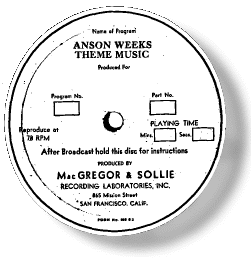 15-minute
programs, with Walter Bunker, Jr., announcer for the nightly KFRC broadcasts. Though
supposedly set at Hotel Mark Hopkins, with Bunker’s constant references to
“gay, suave, sophisticated dancers” or the “lush decor of Peacock
Court,” those transcriptions were recorded in the 865 Mission Street studio
of MacGregor and Sollie. 15-minute
programs, with Walter Bunker, Jr., announcer for the nightly KFRC broadcasts. Though
supposedly set at Hotel Mark Hopkins, with Bunker’s constant references to
“gay, suave, sophisticated dancers” or the “lush decor of Peacock
Court,” those transcriptions were recorded in the 865 Mission Street studio
of MacGregor and Sollie.
A five-minute sample of those MacGregor
and Sollie transcriptions may be heard here in the MP3 format. The MP3 file
is approximately 2 meg.
The three songs excerpted from the Hotel Mark Hopkins broadcasts are valuable
examples of what made Weeks’ orchestra one of the most danceable in the nation.
The excerpt opens with Mr. Bunker discussing the success of the orchestra, in Peacock
Court of Hotel Mark Hopkins, with Anson Weeks. That is the cue to begin a medley
of two songs, “Singin’ in the Rain” introduced in the MGM talking
picture The Hollywood Revue
of 1929, and the old standard, “Sweet Georgia Brown.” The
third selection from this broadcast excerpt is very obscure, but an outstanding
example of why Anson Weeks was so popular. “’Round My Heart” showcases
a sensational piano duet performed by Mr. Weeks, and future bandleader Griff Williams.
The duet begins quietly behind the vocal chorus, and then continues for a chorus.
Note that a string bass is used through most of the performance, and then a tuba
is used following the piano duet. “’Round My Heart” is copyright 1932
by Famous Music (now Paramount-owned). Lyrics are by Joe Young, with music by Carmen
Lombardo, the co-composer of “Coquette” and other hit songs of the era.
An almost complete Anson Weeks broadcast,
is available online. This broadcast features the original 1932 opening announcement,
first and second selections, and the closing song of the broadcast. The medley has
been deleted because it was relatively pedestrian.
This broadcast opens with Walter Bunker, Jr., introducing a new Gershwin
song, “Delicious.” The second song of the broadcast is “Why?”
The dialogue between Mr. Bunker and Mr. Weeks, extolling Hotel Mark Hopkins, is
intact through the introduction of the medley. The medley has been deleted, and
goes directly from the introduction to the last song, “China Boy,” the
treatment of which strongly suggests that the Weeks organization could have been
a formidable jazz presence in San Francisco. It can best be described as “hot.”
This broadcast was digitally encoded from the 1932 MacGregor and Sollie transcription
disc. Walter Bunker, Jr., the announcer, told the Museum’s webmaster that these
broadcasts were recorded directly to disc, with no retakes, because there were then
no editing facilities for wax recordings. Mr. Bunker currently (2000) lives in Pebble
Beach, California.
Return to the top of the page.
This site and contents ©1995-2013 The Museum of the City
of San Francisco
|