
|
||||
|
|
|
|
||
|
|
||||
|
|
|
|
||
|
|
||||
|
|||||||||||||||||||
|
Dorothea Lange Photos of Manzanar and Tanforan Assembly Centers |
Dorothea Lange and the Relocation of the Japanese
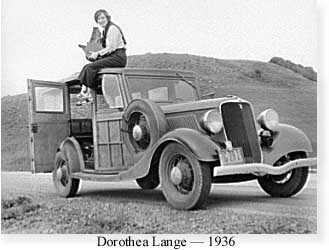
Dorothea Lange (1895-1965) had early interest in photography. She worked with Arnold
Genthe, and had her own photography studio in San Francisco. She was part of the
West Coast Bohemian group of photographers, and later married — and divorced
— famed artist Maynard Dixon.
In the 1930s she was involved with the migrant farm workers program of the California
Emergency Relief Administration, and later began photographic assignments for the
U.S. governments Farm Security Administration, Office of War Information, as well
as the War Relocation Authority, from which these photographs are drawn.
Lange, the Library of Congress wrote:
... documented the change on the homefront, especially among ethnic groups
and workers uprooted by the war. Three months after Pearl Harbor, President Franklin
Roosevelt ordered the relocation of Japanese-
Lange’s earlier work documenting displaced farm families and migrant
workers during the Great Depression did not prepare her for the disturbing racial
and civil rights issues raised by the Japanese internment. Lange quickly found herself
at odds with her employer and her subjects’ persecutors, the United States
government.
To capture the spirit of the camps, Lange created images that frequently
juxtapose signs of human courage and dignity with physical evidence of the indignities
of incarceration. Not surprisingly, many of Lange’s photographs were censored
by the federal government, itself conflicted by the existence of the camps.
The true impact of Lange’s work was not felt until 1972, when the
Whitney Museum incorporated twenty-
Online documentation provided by the Library of Congress is relatively skimpy and poor, however, all of the exhibited photographs were taken in San Francisco.
Lange at Work
These photographs were taken at the Wartime Civil Control Administration
building, 2020 Van Ness Ave., April 6, 1942.
Interrupted Lives
A Compassionate
Eye
The next photograph was taken at Raphael Weill Elementary School, O'Farrell
and Buchanan streets. Weill was a noted San Franciscan who founded the White House
Department Store.
Salute of Innocence
Air raid shelter instructions, as well as orders for Japanese Americans,
posted in the area of Battery and Sansome streets. The first building listed on
the shelter instructions, National Biscuit Co., 815 Battery Street, currently houses
KPIX-TV and other CBS broadcast properties in San Francisco.
Prelude to the
Japanese Exodus Paul Schuster Taylor, author of the next exhibited item, met Dorothea Lange in the early 1930s while she was involved with the California State Emergency Relief Administration, (SERA) working with migratory laborers. He married Lange after her divorce from famed artist Maynard Dixon. Taylor, a social scientist and prolific writer, wrote “Organization and policies of the Sailors’ Union of the Pacific,” in 1922 as his UC Berkeley Ph. D. thesis. Through the 1930s he wrote extensively about migrant farmer issues in California and Texas, and collaborated with Lange on “American Exodus, a Record of Human Erosion in the Thirties,” published in 1939 by Reynal and Hitchcock. Following World War II, Taylor was deeply involved in the University of California loyalty oath controversy, and, from the 1950s to the 1970s, wrote extensively about California water issues. In 1970, he authored “Communist Strategy and Tactics of Employing Peasant Dissatisfaction over Conditions of Land Tenure for Revolutionary Ends in Vietnam” for the House Foreign Operations and Government Information Subcommittee.
The Libary of Congress exhibit includes pages from “Our stakes in
the Japanese Exodus” by Paul S. Taylor, published by Survey Associates of Stroudsburg,
Pennsylvania. The article is extracted from “Survey Graphic”—
Impact of Internment Camps Examined
One of the Library of Congress exhibits is of general Bay Area interest.
“Richmond Took a Beating” details the impact of the war, and construction
of Kaiser Shipyards, on the small community across the Bay.
Condition of War Workers Profiled
Comments about the Library of Congress’ online exhibit may be directed
to: lcweb@loc.gov
Go to the Japanese Internment page. Return to the top of the page. |


 Dorothea Lange’s photographs of the forced relocation of Japanese
and Japanese American citizens are part of a Library of Congress’ online exhibit
Dorothea Lange’s photographs of the forced relocation of Japanese
and Japanese American citizens are part of a Library of Congress’ online exhibit
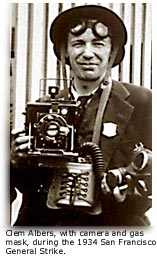 The first photograph, “Lange at Work,” was not taken by her,
but most likely by Clem Albers, a former San Francisco Chronicle photographer
who then worked for the War Relocation Authority. The picture shows Lange positioned,
at far right, to photograph the internees. This uncredited photograph was taken
at the Wartime Civil Control Administration building, 2020 Van Ness Ave. These internees
would have been among the 664 Japanese moved to Santa Anita Race Track, in Southern
California, to wait the opening of Manzanar. They were
The first photograph, “Lange at Work,” was not taken by her,
but most likely by Clem Albers, a former San Francisco Chronicle photographer
who then worked for the War Relocation Authority. The picture shows Lange positioned,
at far right, to photograph the internees. This uncredited photograph was taken
at the Wartime Civil Control Administration building, 2020 Van Ness Ave. These internees
would have been among the 664 Japanese moved to Santa Anita Race Track, in Southern
California, to wait the opening of Manzanar. They were 


