Sally Rand (1904-1979)
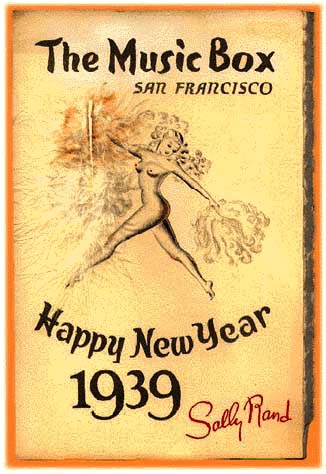 Rare
menu from The Music Box, Sally Rand’s nightclub, then located at 859 O’Farrell
Street, in the Polk Gulch district of San Francisco. The building, opened as Blanco's
after the Great Earthquake, currently houses the Great American Music Hall, and
the interior remains much as it did when Rand performed her famed fan dances there.
The venue was sold in 2000 to Palo Alto-based
Riffage.com, a dot-com startup, that planned live Internet broadcasts of
new music from the former Music Box. Riffage.com, unfortunately, ceased operations
Dec. 8, 2000. Its website said, “we cannot continue to service these fine [music]
communities in the current economic marketplace.” The Great American Music
Hall was
put up for sale by the company. Rare
menu from The Music Box, Sally Rand’s nightclub, then located at 859 O’Farrell
Street, in the Polk Gulch district of San Francisco. The building, opened as Blanco's
after the Great Earthquake, currently houses the Great American Music Hall, and
the interior remains much as it did when Rand performed her famed fan dances there.
The venue was sold in 2000 to Palo Alto-based
Riffage.com, a dot-com startup, that planned live Internet broadcasts of
new music from the former Music Box. Riffage.com, unfortunately, ceased operations
Dec. 8, 2000. Its website said, “we cannot continue to service these fine [music]
communities in the current economic marketplace.” The Great American Music
Hall was
put up for sale by the company.
Sally Rand came to prominence during the 1933-1934 Chicago Century of
Progress world’s fair that was to celebrate the progress of civilization during
Chicago’s first century of existence.
The Chicago fair opened May 27, 1933, and drew 39,000,000 visitors. Like
the Treasure Island fair, it was repeated a year later. The Century of Progress
is, incidentally, one of the few world’s fairs that did not lose money.
This was the fair that made Sally Rand famous. She had been a nightclub
cigarette girl and dancer, and joined a chorus line at the fair. She was arrested
for an “obscene” performance, and was catapulted to fame. It is said her
act, in Chicago, grossed $6,000 per week during the depths of the Depression. After
the Chicago fair closed she performed in vaudeville, motion pictures, expositions
in Texas and San Diego, then came to San Francisco in anticipation of the 1939 Treasure
Island World’s Fair.
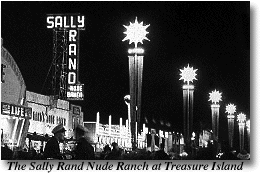
In the Treasure
Island amusement zone, known as the “Gayway,” was the Sally Rand
Nude Ranch, one of the highlights of the fair. It featured women wearing cowboy
hats, gunbelts and boots, and little else. The fair’s Official Guide Book
delicately described it as “Sally Rand Nude Ranch: A dude ranch a la 1939.”
 The
Nude Ranch was just one of several “flesh” shows at the Treasure Island
Fair. Others included Candid Camera, which featured
live, nude, models, and Greenwich Village, described by the Official Guide Book
as “Model artists’ colony and revue theatre.” The
Nude Ranch was just one of several “flesh” shows at the Treasure Island
Fair. Others included Candid Camera, which featured
live, nude, models, and Greenwich Village, described by the Official Guide Book
as “Model artists’ colony and revue theatre.”
 The
Gayway also featured the Mark Twain House, a replica of a newspaper office where
the famed author worked, and Incubator Babies, Inc., with live infants in a modern
hospital—
on display at the fair. The
Gayway also featured the Mark Twain House, a replica of a newspaper office where
the famed author worked, and Incubator Babies, Inc., with live infants in a modern
hospital—
on display at the fair.
Unabashed stag shows at Treasure Island did cause some controversy. However,
one San Francisco neighborhood newspaper, the Polk Progress, wrote:
“One might gather from the snickering and naughty attitude toward
the ‘flesh’ shows at the Exposition, that the success of the $50,000,000
enterprise hangs or fails upon the relative number of inches of epidermis displayed.
Bringing stag shows out into the open in order that women may attend and feel devilish
will pay good dividends, but the marvelous exhibitions of paintings and other displays
will also attract a few.”
Sally Rand, who said she was born in 1904, may have been an “overnight
sensation” in Chicago, but had appeared in motion pictures and vaudeville from
the 1920s. Her screen credits include 1924s “The Dressmaker from Paris,”
two Rod La Rocque 1926 films “Bachelor Brides,” and “Gigolo,”;
“Getting Gertie’s Garter” in 1927, as well as Cecil B. De Mille’s
“King of Kings.” She was in the 1928 film “The Fighting Eagle,”
and the 1934 musical “Bolero,” with George Raft. She also appeared in
two “Soundies” features filmed in 1942 - “The Fan Dancer” and
“The Artist Model.”
Return to top of page
|