Biography of Junípero Serra
The Founding of
San Francisco, by Edward F. O’Day
Founding of the
Mission Dolores
Missions of the Spanish Era had Wide Influence,
by F. Gordon O’Neill
“Ranch and Mission Days in Alta California,” By Guadalupe Vallejo
Bells of the Mission Dolores Basilica (in RealAudio)
Father Serra's biography from The Catholic Encyclopedia.
|
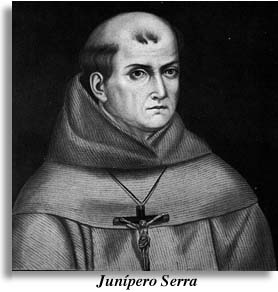 Junípero Serra, the founder of the Missions, which were the first settlements
of civilized man in California, was born on the island of Majorca, part
of the kingdom of Spain, on the 24th of November, 1713. At the age of sixteen,
he became a Monk of the order of St. Francis, and the new name of Junípero
was then substituted for his baptismal name of Miguel José. After
entering the convent, he went through a collegiate course of study, and
before he had received the degree of Doctor, was appointed lecturer upon
philosophy. He became a noted preacher, and was frequently invited to visit
the larger towns of his native island in that capacity. Junípero Serra, the founder of the Missions, which were the first settlements
of civilized man in California, was born on the island of Majorca, part
of the kingdom of Spain, on the 24th of November, 1713. At the age of sixteen,
he became a Monk of the order of St. Francis, and the new name of Junípero
was then substituted for his baptismal name of Miguel José. After
entering the convent, he went through a collegiate course of study, and
before he had received the degree of Doctor, was appointed lecturer upon
philosophy. He became a noted preacher, and was frequently invited to visit
the larger towns of his native island in that capacity.
Junípero was thirty-six years of age when he determined to become
a missionary in the New World. In 1749 he crossed the ocean in company
with a number of Franciscan Monks, among them several who afterward came
with him to California. He remained but a short time in the City of Mexico,
and was soon sent a missionary to the Indians in the Sierra Madre, in the
district now known as the State of San Luis Potosi. He spent nine years
there, and then returned to the City of Mexico where he stayed for seven
years, in the Convent of San Fernando.
In 1767, when he was fifty-four years of age, he was appointed
to the charge of the Missions to be established in Upper California. He
arrived at San Diego in 1769, and, with the exception of one journey to
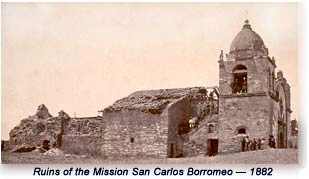
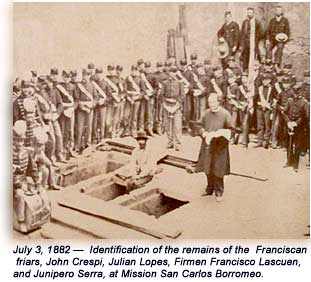
Mexico, he spent all the remainder of his life here. He died at the Mission [San Carlos Borromeo]
of Carmel, near Monterey, on the 28th of August, 1784, aged seventy- one
years.
 Our knowledge of his character is derived almost exclusively from his
biography by Palou, who was also a native of Majorca, a brother Franciscan
Monk, had been his disciple, came across the Atlantic with him, was his
associate in the college of San Fernando, his companion in the expedition
to California, his successor in the Presidency of the Missions of Old California,
his subordinate afterward in New California, his attendant at his
death-bed, and his nearest friend for forty years or more. Under the circumstances,
Palou had the right to record the life of his preceptor and superior. Our knowledge of his character is derived almost exclusively from his
biography by Palou, who was also a native of Majorca, a brother Franciscan
Monk, had been his disciple, came across the Atlantic with him, was his
associate in the college of San Fernando, his companion in the expedition
to California, his successor in the Presidency of the Missions of Old California,
his subordinate afterward in New California, his attendant at his
death-bed, and his nearest friend for forty years or more. Under the circumstances,
Palou had the right to record the life of his preceptor and superior.
Junípero Serra, as we ascertain his character directly and inferentially
in his biography, was a man to whom his religion was every thing. All his
actions were governed by the ever-present and predominant idea that
life is a brief probation, trembling between eternal perdition on one side,
and salvation on the other. Earth for its own sake, had no joys for him.
His soul did not recognize this life as its home. He turned with dislike
from nearly all the sources of pleasure in which the polished society of
our age delights. As a Monk he had, in boyhood renounced the joys of love,
and the attractions of woman’s society. The conversation of his own sex
was not a source of amusement. He was habitually serious. Laughter was
inconsistent with the terrible responsibilities of his probationary existence.
Not a joke or a jovial action is recorded of him. He delighted in no joyous
books. Art or poetry never served to sharpen his wits, lighten his spirit,
or solace his weary moments. The sweet devotional poems of Fray Luis de
Leon, and the delicate humor of Cervantes, notwithstanding the perfect
piety of both, were equally strange to him. He knew nothing of the science
and philosophy which threw all enlightened nations into fermentation a
hundred years ago. The rights of man and the birth of chemistry did not
withdraw his fixed gaze from the other world, which formed the constant
subject of his contemplation.
 It was not sufficient for him to abstain from positive pleasure; he
considered it his duty to inflict upon himself bitter pain. He ate little,
avoided meat and wine, preferred fruit and fish, never complained of the
quality of his food, nor sought to have it more savory. He often lashed
himself with ropes, sometimes of wire; he was in the habit of beating himself
in the breast with stones, and at times he put a burning torch to his breast.
These things he did while preaching or at the close of his sermons, his
purpose being, as his biographer says, “not only to punish himself but
also to move his auditory to penitence for their own sins.”
It was not sufficient for him to abstain from positive pleasure; he
considered it his duty to inflict upon himself bitter pain. He ate little,
avoided meat and wine, preferred fruit and fish, never complained of the
quality of his food, nor sought to have it more savory. He often lashed
himself with ropes, sometimes of wire; he was in the habit of beating himself
in the breast with stones, and at times he put a burning torch to his breast.
These things he did while preaching or at the close of his sermons, his
purpose being, as his biographer says, “not only to punish himself but
also to move his auditory to penitence for their own sins.”
We translate the following incident, which occurred during a sermon which
he delivered in Mexico, the precise date and place are not given:—
“Imitating his devout San Francisco Solano, he drew out a chain,
and letting his habit fall below his shoulders, after having exhorted his auditory
to penance, he began to beat himself so cruelly that all the spectators were moved
to tears, and one man rising up from among them, went with all haste to the pulpit
and took the chain from the penitent father, came down with it to the platform of
the presbiterio, and following the example of the venerable preacher, he
bared himself to the waist and began to do public penance, saying with tears and
sobs, ‘I am the sinner, ungrateful to God, who ought to do penance for my many
sins, and not the father who is a saint.’ So cruel and pitiless were the blows,
that, in the sight of all the people, he fell down, they supposing him to be dead.
The last unction and sacrament were administered to him there, and soon afterward
that he died. We may believe with pious faith, that this soul is enjoying the presence
of God.”
Serra, and his biographer, did not receive the Protestant doctrine, that
there have been no miracles since the Apostolic age. They imagined that the power
possessed by the chief disciples of Jesus had been inherited by the Catholic priests
of their time, and they saw wonders where their contemporary clergymen, like Conyers,
Middleton, and Priestly, saw nothing save natural mistakes. Palou records the following
story, with unquestioning faith:—
“When he [Serra] was traveling with a party of missionaries through
the province of Huasteca [in Mexico], many of the villagers did not go to hear the
word of God at the first village where they stopped; but scarcely had the fathers
left the place when it was visited by an epidemic, which carried away sixty villagers,
all of whom, as the curate of the place wrote to the reverend father Junípero,
were persons who had not gone to hear the missionaries. The rumor of the epidemic
having gone abroad, the people in other villages were dissatisfied with their curates
for admitting the missionaries; but when they heard that only those died who did
not listen to the sermons, they became very punctual, not only the villagers, but
the country people dwelling upon ranchos many leagues distant.
“Their apostolic labors having been finished, they were upon their
way back, and at the end of a few days’ journey, when the sun was about to
set, they knew not where to spend the night, and considered it certain that they
must sleep upon the plain. They were thinking about this when they saw near the
road a house, whither they went and solicited lodging. They found a venerable man,
with his wife and child, who received them with much kindness and attention, and
gave them supper. In the morning, the Fathers thanked their hosts, and taking leave,
pursued their way. After having gone a little distance they met some muleteers,
who asked them where they had passed the night. When the place was described, the
muleteers declared that there was no such house or ranche near the road, or within
many leagues. The missionaries attributed to Divine Providence the favor of that
hospitality, and believed without doubt that these hosts were Jesus, Mary, and Joseph,
reflecting not only about the order and cleanness of the house (though poor), and
the affectionate kindness with which they had been received, but also about the
extraordinary internal consolation which their hearts had felt there.”
Serra’s religious conviction found in him a congenial mental constitution.
He was even- tempered, temperate, obedient, zealous, kindly in speech, humble and
quiet. His cowl covered neither greed, guile, hypocrisy, nor pride. he had no quarrels
and made no enemies. He sought to be a monk, and he was one in sincerity. Probably
few have approached nearer to the ideal perfection of a monkish life than he. Even
those who think that he made great mistakes of judgment in regard to the nature
of existence and the duties of man to society, must admire his earnest, honest and
good character.
Alta California
October 31, 1862
Return to the top of the page.
|